
Remembering the Faithfulness of God in the Wilderness
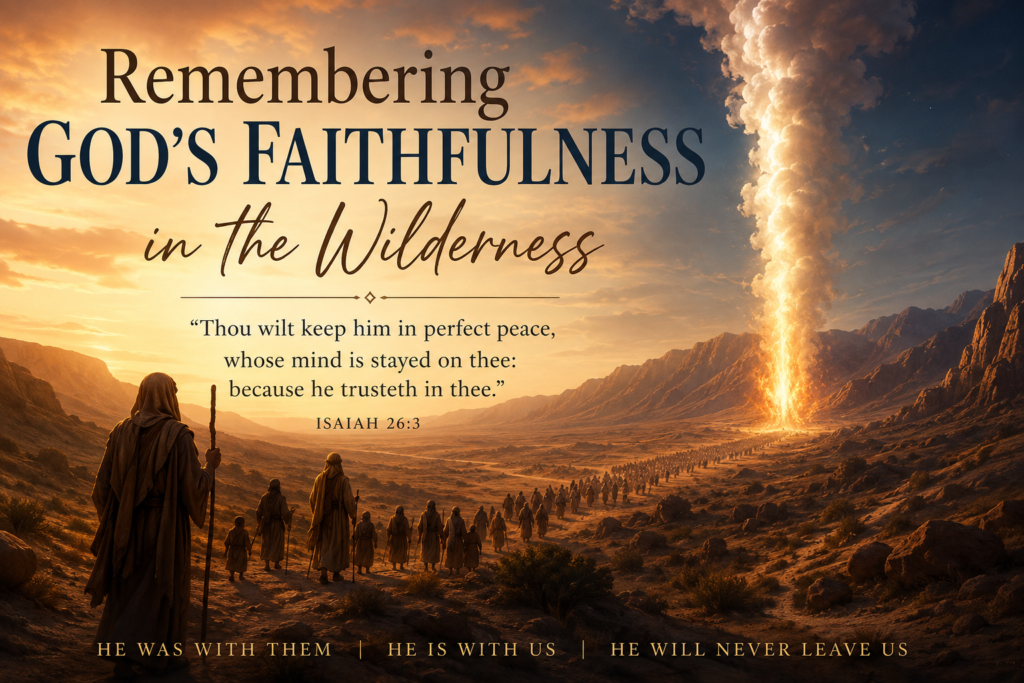
“Thou wilt keep him in perfect peace, whose mind is stayed on thee: because he trusteth in thee.” — Isaiah 26:3
Introduction
Some truths in Scripture are understood long before they are experienced. Others are experienced long before they are understood. Then there are those rare moments when experience and Scripture suddenly meet, and what was once familiar becomes illuminated in an entirely new way.
Recently, Isaiah 26:3 caught my attention. I read the verse as though it simply taught that peace comes from fixing our minds on God. While that is certainly true, I had overlooked a small but profound phrase:
“…whose mind is stayed on thee: because he trusteth in thee.”
The mind remains fixed because it trusts. That single observation sent me on a journey through Scripture and, unexpectedly, back through my own life, and I began to see a pattern woven throughout the Bible. Trust, remembrance, testimony, and the Presence of God are not isolated themes. They are deeply connected. Now I realise that remembering the faithfulness of God is crucial in our walk with God.
Trust Anchors the Mind
We often think of trust as something that follows peace. Isaiah reverses the order. Trust anchors the mind. The anchored mind experiences peace. The mind does not remain fixed on someone it does not trust. This brings another passage to mind:
“But without faith it is impossible to please him: for he that cometh to God must believe that he is, and that he is a rewarder of them that diligently seek him.” (Hebrews 11:6)
Notice what faith believes, not merely that God exists: but that He is; That He is good; That He is faithful; That He is a rewarder of those who diligently seek Him. Trust is not simply confidence in God’s power. It is confidence in His character. It is the confidence that keeps us coming to Him because we have learned who He is. Trust becomes the anchor that steadies the heart.
Perhaps no story illustrates this more vividly than Peter walking on the sea. When Jesus said, “Come,” Peter stepped out of the boat and walked on water. The storm had not ceased. The wind had not become gentler. The waves had not become smaller. What enabled Peter to do the impossible was not the absence of the storm but confidence in the One who had called him.
Then Matthew records a subtle but significant change:
“But when he saw the wind boisterous, he was afraid…” (Matthew 14:30)
The storm had been there all along. What changed was Peter’s focus. Fear began to replace trust. His attention shifted from Christ to his circumstances. Isaiah’s words suddenly become wonderfully practical.
“Thou wilt keep him in perfect peace, whose mind is stayed on thee: because he trusteth in thee.”
Trust steadies the mind. The steadied mind remains fixed upon Christ. When trust shifts, our attention often follows. Yet Peter’s story does not end with failure. Before he could drown, Jesus reached out His hand and caught him. Even when Peter’s trust faltered, Christ’s faithfulness did not. That, perhaps, is one of the greatest comforts of the Christian life. Our confidence ultimately rests not in the perfection of our faith, but in the unfailing faithfulness of the One in whom we place it.
The School of Remembrance
Another question emerges naturally: How is trust sustained? The answer began appearing repeatedly throughout Scripture.
Remember.
David exhorts himself:
“Bless the LORD, O my soul, and forget not all his benefits.” (Psalm 103:2)
Joshua erected twelve stones after Israel crossed the Jordan. Why? So that future generations would ask:
“What mean these stones?” (Joshua 4:6)
And the answer would not simply be information. It would be testimony.
In Deuteronomy, God anticipated a day when children would ask about His commandments. The parents were instructed to answer, not first with rules, but with redemption:
“We were Pharaoh’s bondmen in Egypt; and the LORD brought us out…” (Deuteronomy 6:20–25)
Psalm 78 gives the reason:
“…shewing to the generation to come the praises of the LORD… that they might set their hope in God, and not forget the works of God.” (Psalm 78:4–7)
A pattern emerges: God acts; His people remember; They testify. Hope is strengthened. Trust grows.
Remembrance is not nostalgia. It is one of God’s appointed means of sustaining faith.
The Presence in the Wilderness
This provides a different view about Israel’s journey through the wilderness. God could have guided Israel without a visible pillar of cloud by day and fire by night. Yet He chose not to. Every morning they could look up and see the cloud. Every evening they could see the fire. The wilderness remained a wilderness. The heat did not disappear. The journey was still long. Every glance upward reminded them of one unchanging reality:
The Lord was with them.
Perhaps that visible manifestation was more than guidance. It was continual reassurance of His Presence. A daily reminder that God had not abandoned His people.
Imagine standing at the edge of the Red Sea as the dust from Pharaoh’s advancing army filled the horizon. This was no imagined threat. Horses. Chariots. Seasoned soldiers. Humanly speaking, fear was inevitable. Yet before God destroyed the Egyptian army, He did something remarkable. He did not first remove the danger. He reminded His people of His Presence.
“And the angel of God, which went before the camp of Israel, removed and went behind them; and the pillar of the cloud went from before their face, and stood behind them.”
Exodus 14:19
The cloud became more than a guide. It became a shield. The circumstances had not yet changed. The sea had not yet parted. The enemy had not yet been judged. But one reality had become unmistakable.
God was there.
Perhaps that is one of the profound lessons of the pillar of cloud and the pillar of fire. They continually testified that God’s Presence had not departed, even while His people stood in circumstances that appeared impossible. Before the miracle came, God gave them a reason to trust. Before He changed their circumstances, He assured them they would not face them alone.
Faithfulness Looks Different Than We Often Imagine
Many of us instinctively measure God’s faithfulness by the absence of hardship. Scripture does not. Joseph experienced prison before the palace. David fled before wearing the crown. Paul carried burdens while proclaiming Christ. Yet one phrase quietly echoes throughout their stories:
The LORD was with them.
Looking back over my own journey, I have come to appreciate this more deeply. There were seasons when circumstances were uncertain, plans failed, and the future seemed anything but clear. Yet, strangely, those same seasons became some of the richest periods of spiritual growth and increasing appreciation of God’s Word. At the time, I could not understand why, but looking back now, I realize that His faithfulness was not demonstrated by removing every difficulty. It was demonstrated by sustaining me through them. His Presence proved more constant than my circumstances. What once confused me has now become part of my testimony.
The Word of Their Testimony
This perhaps sheds fresh light on a familiar verse:
“And they overcame him by the blood of the Lamb, and by the word of their testimony…” (Revelation 12:11)
The foundation of our victory is never our experience. It is always the blood of the Lamb. Yet Scripture also speaks of “the word of their testimony.” Throughout the Bible, God’s people repeatedly declare what He has done. Not to magnify themselves. But to magnify His faithfulness. Testimony is remembered faithfulness given a voice. It strengthens the one who remembers. It encourages those who hear. It reminds both speaker and listener that the God who was faithful before remains faithful still.
David stood before Goliath remembering the lion and the bear. Israel remembered Egypt. Samuel raised an Ebenezer and declared:
“Hitherto hath the LORD helped us.” (1 Samuel 7:12)
Every testimony became another reason to trust.
An Anchor That Holds
Perhaps that is why Isaiah’s words have taken on new meaning for me.
“Thou wilt keep him in perfect peace, whose mind is stayed on thee: because he trusteth in thee.”
Trust is not sustained by ignoring life’s realities. It is sustained by remembering a greater reality. The God who has been faithful remains faithful. The God who has carried us before has not changed. The God whose Presence sustained His people in the wilderness still walks with His people today.
Perhaps this is why remembrance occupies such a central place in Scripture. Because what we remember shapes what we trust. What we trust determines where our minds rest. And where our minds rest often determines how we walk through tomorrow. Maybe today is a good day to remember. Not because life is without difficulty. But because God’s faithfulness has never depended upon the absence of it.
Like Israel looking up at the pillar of cloud, we too have reasons to remember that the Lord has not left us. And every remembered act of His goodness becomes another anchor for the soul.
“Bless the LORD, O my soul, and forget not all his benefits.” (Psalm 103:2)
Conclusion
The wilderness may not disappear overnight, but remembered faithfulness reminds us that we never walk through it alone. The God who sustained His people then still sustains His people now. His Presence remains our greatest assurance, and every remembered act of His goodness becomes another anchor for the soul.
Pause for a moment. What “Ebenezers” has God placed along your journey? What wildernesses has He sustained you through? Remember them. Tell them. They may become the very anchors that steady your heart, and someone else’s, in seasons yet to come.
God bless you and may you stand firm in your faith in your season of trial. He is faithful and never fails: His mercies are new every morning.
Thank you for reading. God bless you.
Please share this post to bless others.